Rooted in Two Worlds: How Second-Generation American Muslims Are Rediscovering the Quran on Their Own Terms

Photo: Dinoeyad, CC BY-SA 4.0, via Wikimedia Commons
Growing up Muslim in America often means inhabiting two distinct vocabularies simultaneously. There is the language of Friday khutbahs, Ramadan iftars, and Quranic recitation that fills the home—and then there is the language of high school hallways, college campuses, and workplace water coolers. For decades, many children of immigrant Muslim families navigated these parallel worlds by keeping them carefully separate. Today, however, a growing number of second-generation American Muslims are doing something altogether different: they are bringing those worlds together, and the Quran is at the center of that convergence.
A Generational Shift in Quranic Engagement
The pattern is visible in Islamic centers from Dearborn, Michigan, to Houston, Texas, to the suburbs of northern New Jersey. Young Muslims in their twenties and thirties—many of whom grew up memorizing Arabic verses without fully understanding their meanings—are returning to the Quran with a different set of questions. They want to know not just how to recite, but what the words mean, why specific passages were revealed, and how ancient wisdom speaks to thoroughly modern American circumstances.
This shift is partly generational and partly technological. Access to high-quality English translations, tafsir lectures on YouTube, and live Quranic instruction through platforms like Live Quran has democratized Islamic learning in ways that were simply unavailable to the generation before. A twenty-six-year-old software engineer in Austin can now study Surah Al-Baqarah with a qualified scholar in real time, revisit the session recording the following morning, and discuss its implications in an online study circle that afternoon—all without leaving home.
But the shift is also deeply personal. Many second-generation Muslims describe a moment of reckoning, often arriving in young adulthood, when the faith of their parents either becomes their own or quietly recedes. For a significant number, the Quran itself became the turning point.
Finding Personal Relevance in Sacred Text
"My parents recited beautifully, but I never really understood what I was saying," says one young woman from the Chicago area who asked to be identified only as Amina. "When I finally sat down with a good translation and a tafsir, I felt like I was reading the Quran for the first time. It was speaking directly to me—to my doubts, my questions, my actual life."
This search for personal relevance is one of the defining characteristics of second-generation Quranic engagement. Rather than treating the text primarily as a ritual obligation, younger American Muslims are increasingly approaching it as a living source of guidance. They are drawn to passages that address justice, mental health, community, and the complexity of human relationships—themes that resonate with their lived experience as Americans navigating questions of identity, belonging, and purpose.
English-language commentary has played a critical role in this development. Scholars such as Nouman Ali Khan, who built an enormous following among young American Muslims by grounding Quranic lessons in relatable, contemporary language, demonstrated that deep Quranic study need not feel foreign or inaccessible. Their influence helped legitimize the idea that engaging with the Quran in English is not a compromise but a genuine pathway to understanding.
Community-Driven Learning and the New Islamic Classroom
Perhaps the most striking feature of this generational renewal is its communal character. Second-generation Muslims are not simply studying the Quran in isolation; they are building learning communities that reflect their hybrid identities.
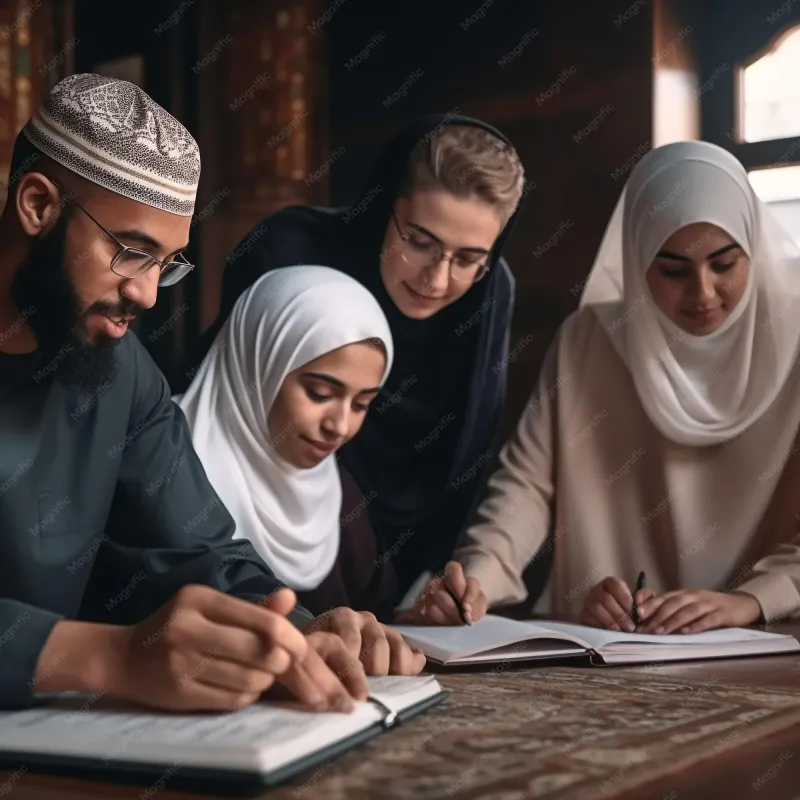
Halaqas—informal Quranic study circles—have long existed in Muslim communities, but today's versions often look quite different from their predecessors. Mixed-gender circles meeting in coffee shops, apartment living rooms, and university student centers have become common in major American cities. These gatherings typically blend Arabic recitation practice with English-language discussion, encouraging participants to connect Quranic themes to current events, personal struggles, and social questions.
Some of these informal groups have grown into more structured institutions. Organizations founded and led by second-generation Muslims are now offering systematic Quranic curricula that integrate classical scholarship with contemporary pedagogy. Several such initiatives have partnered with live online instruction platforms to extend their reach beyond local communities, making rigorous Quranic education available to American Muslims in cities and towns where Islamic educational infrastructure remains limited.
Profiles in Scholarship: A New Generation of Quranic Educators
The most visible expression of this renewal is the emergence of second-generation Quranic scholars who are actively reshaping Islamic education in the United States. These individuals—many of whom pursued advanced Islamic studies abroad before returning to serve American Muslim communities—occupy a unique position. Fluent in both classical Arabic and contemporary American cultural discourse, they are capable of communicating Quranic wisdom in ways that feel immediately relevant to their peers.
Their work is consequential not only for its content but for its form. Second-generation scholars are pioneering new models of Quranic instruction that prioritize accessibility without sacrificing depth. They are writing commentary in clear, literary English. They are designing curricula that meet adult learners where they are. They are using digital platforms to reach Muslims in underserved communities. And they are modeling, through their own lives, what it means to be fully American and fully committed to the Quranic tradition.
Navigating Tensions with Humility and Purpose
This renewal is not without its tensions. Some first-generation Muslims express concern that emphasis on English-language study or personal interpretation risks diluting the classical tradition. Questions about authority, methodology, and the boundaries of legitimate interpretation remain live and sometimes contentious within American Muslim communities.
Second-generation learners tend to navigate these tensions with a characteristic combination of respect and independence. They revere the classical tradition and generally seek qualified guidance rather than pursuing solitary interpretation. But they also insist on their right to understand what they recite, to ask difficult questions, and to connect Quranic teachings to the full reality of their American lives.
In this sense, their relationship with the Quran mirrors the broader project of American Muslim identity formation: a patient, sometimes difficult effort to honor inherited wisdom while remaining honest about contemporary experience. The Quran, they are discovering, is more than capacious enough to hold both.